
Capabilities
What we
actually run.
Not a list of what the machines could theoretically do. This is every material we have actually cut, the thicknesses and finishes we have run it in, and every process a part passes through on the way out — counted from production records.
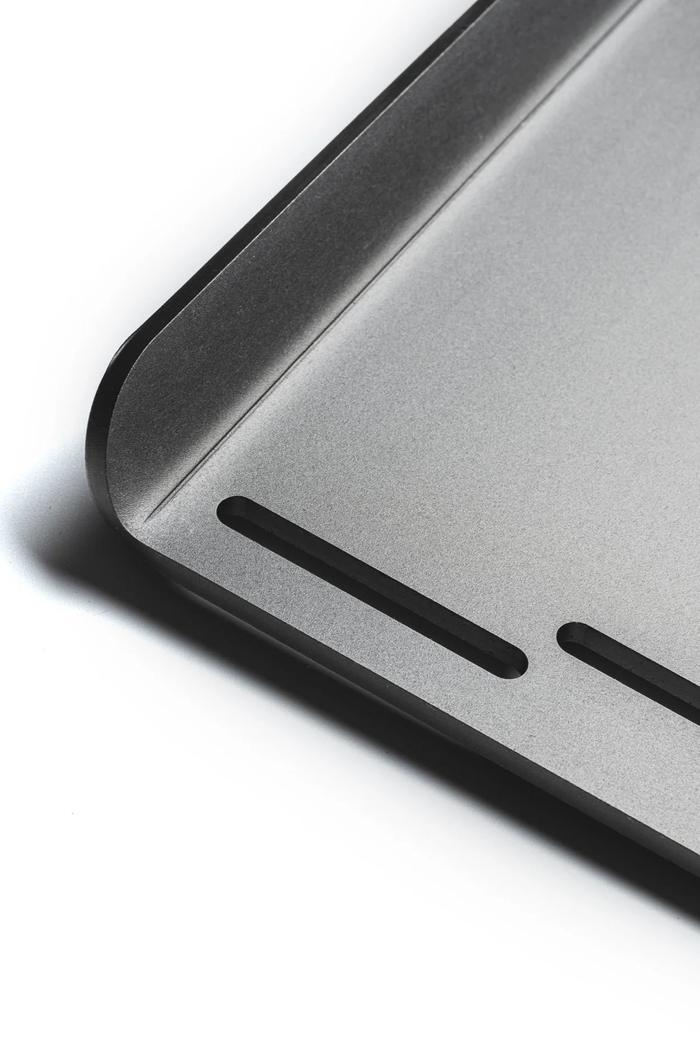
Cutting is done on an Amada Ventis 3015 AJ fiber laser, nested in house so parts from one order share a sheet rather than being run a drawing at a time. Forming is done on an Amada EGB 8025e press brake, and parts that need it are welded, machined, blasted and finished before they are packed.
Maximum sheet on the laser is 60″ × 120″. The thickness ranges below are what we have actually run, not the machine's rated limit — if you need something at the edge of them, ask and we will tell you honestly whether it is a good fit.
| Material | Thickness range | Largest sheet run | Sheets |
|---|---|---|---|
| Mild steel CS-B | 20 ga – 7 ga | 60″ × 120″ | 8,799 |
| Mild steel A36 | 1/8″ – 1″ | 60″ × 120″ | 3,572 |
| Stainless 304 | 20 ga – 1/4″ | 60″ × 120″ | 479 |
| Stainless 430 | 16 ga | 48″ × 96″ | 227 |
| Aluminum 5052 H32 | 0.081″ – 1/8″ | 60″ × 120″ | 124 |
| Carbon steel A572 Gr 50 | 10 ga – 3/4″ | 60″ × 120″ | 43 |
| Stainless 304 perforated | 18 ga | 48″ × 120″ | 28 |
| Aluminum 3003 H22 | 1/8″ | 48″ × 96″ | 19 |
| Stainless 304L | 3/16″ – 1/2″ | 48″ × 96″ | 12 |
| Aluminum 3003 H14 | 0.063″ – 1/8″ | 60″ × 120″ | 9 |
| Aluminum 6061 | 1/4″ – 1/2″ | 60″ × 120″ | 8 |
| Mild steel A1011 CS | 10 ga | 48″ × 96″ | 1 |
- Hot rolled
- HRPO
- Mill finish
- 2B
- #3
- #4
- #8 mirror
- Galvanized
- Galvannealed
- Floor plate
Finish matters as much as grade once a part is going to be seen. These are the ones that have actually come across the table, not a supplier catalog.
Working in something not on this list? Ask. Most of what is here started as a customer asking.
Processes
Every process
a part needs.
The table above is what comes off the laser. That is the first operation, not the whole job — most parts here are cut, formed, welded, machined, blasted and finished without ever leaving the building, and without being crated and trucked between shops to get there.
Each of these is a station in the same production system. A part's route is set before it is cut, and every step it takes is recorded against the job rather than remembered.
Laser cutting
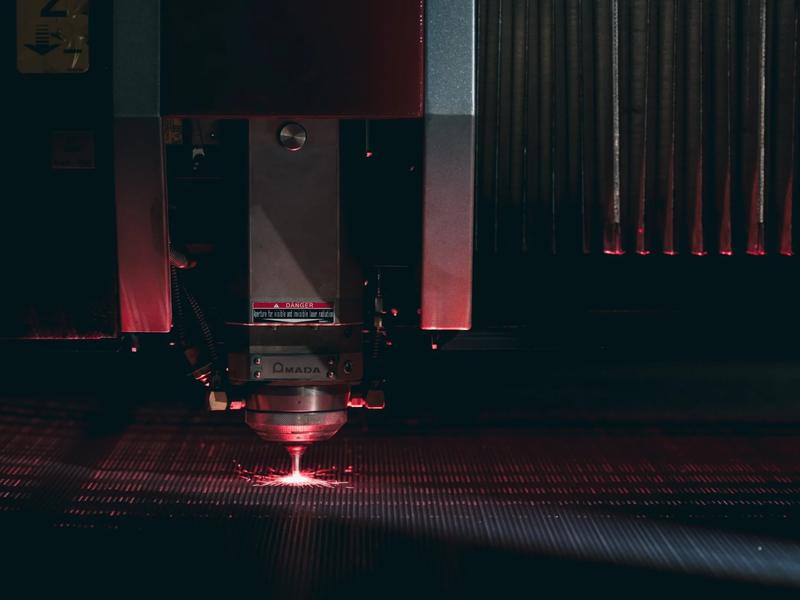
Amada Ventis 3015 AJ fiber laser. Sheet and plate in steel, stainless and aluminum, up to 1″ thick and up to 60″ × 120″. Nesting is done in house, so parts from one order share sheets instead of each drawing being run on its own.
Press brake forming
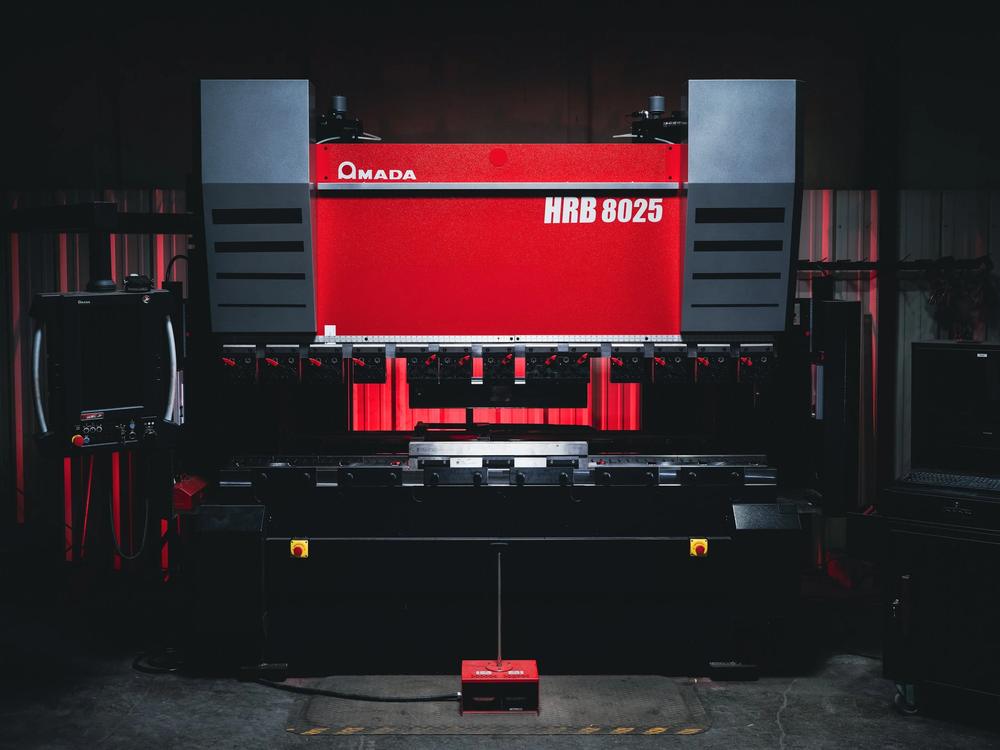
Amada EGB 8025e. Bend allowances are proved on the first piece and held for the run, and where a job needs it parts are kept together by sheet through forming — springback varies sheet to sheet, and mixing them is how out-of-spec bends happen.
Welding and fabrication
MIG and TIG, from a single bracket to a multi-part weldment. The parts being joined were cut and formed here, so fit-up problems get solved at the drawing rather than discovered at the bench.
Structural and tube cutting
Square and rectangular tube, pipe, channel, angle, and round, square and flat bar — cut to length and fed into weldments. This is saw work, not laser work: the Ventis runs flat sheet and plate.
Secondary machining
Drilling, tapping and milling for the features a laser and a brake cannot put in. Scheduled alongside the cutting and forming rather than sent out, so they do not add a week to the lead time.
Blasting and finishing
Media blasting takes mill scale, rust and weld discoloration off so a coating has something to hold onto, and finishing is done before parts are packed. Both are in this building, which is where most finish damage gets avoided.
The one step that leaves
Powder coating is the operation we do not run ourselves. It goes to a finisher we have vetted, and it is booked as a step of your job in the same system as everything else — with a purchase order, a due-back date and a record of what came back. It does not drop off the schedule just because it left the building.
Material
Your metal
or ours.
With multiple deliveries arriving each week, we buy direct rather than through a broker. That constant flow of inbound material is why we can usually get what a job needs quickly, and price it sensibly.
Or send us your own. Customer-supplied material is received, measured and held on our racks under exactly the same records as ours — same traceability back to the purchase order it arrived on, same reporting. It does not become a second-class pile in the corner.
Received, not just accepted
Customer material is booked in with dimensions, grade and the paperwork it arrived with, before it touches a machine.
Tracked like ours
Same stock records, same purchase-order traceability, same consumption history against the jobs that used it.
Remnants inventoried
Offcuts are measured and returned to stock as real material with a record, not scrap on a shelf.
Yours to take back
Remnants can be run on your next job or returned to you, with the traceability that came in still attached.
The offcut is still yours
What is left of your sheet does not get written off or quietly absorbed. Every remnant is measured, labeled and put back on the rack as stock in its own right, with its own record and its own traceability — ready for your next job, or shipped back to you with its history intact.